Push Up Workout: A Practical Guide To Getting Stronger
By:Author:Nordletics Editorial
Updated on:October 28, 2026

- Building Proper Push Up Form Step by Step
- How Many Push Ups You Actually Need per Week
- Fitting a Push Up Routine Into a Busy Week
- A Four Week Starting Structure for Push Ups
- When Push Up Progress Starts to Feel Slow
- Where Push Up Workouts Commonly Go Wrong
- Building a Push Up Workout Habit With Nordletics
- Making the Push Up Workout Part of Your Routine
A push up workout is a short series of push up sets, done a few times a week, that builds chest, shoulder, arm and core strength without any equipment.
The movement works because it loads your own bodyweight against gravity, so your muscles adapt by getting better at handling that load over repeated sessions.
This guide covers the steps to a proper push up, how many reps and sets make sense, a four week starting structure, the mistakes that slow people down, and how to keep the habit going once the first few weeks are over.
Building Proper Push Up Form Step by Step
Good form matters more than rep count, because sloppy reps train bad habits instead of strength.
How to Do a Push Up Correctly
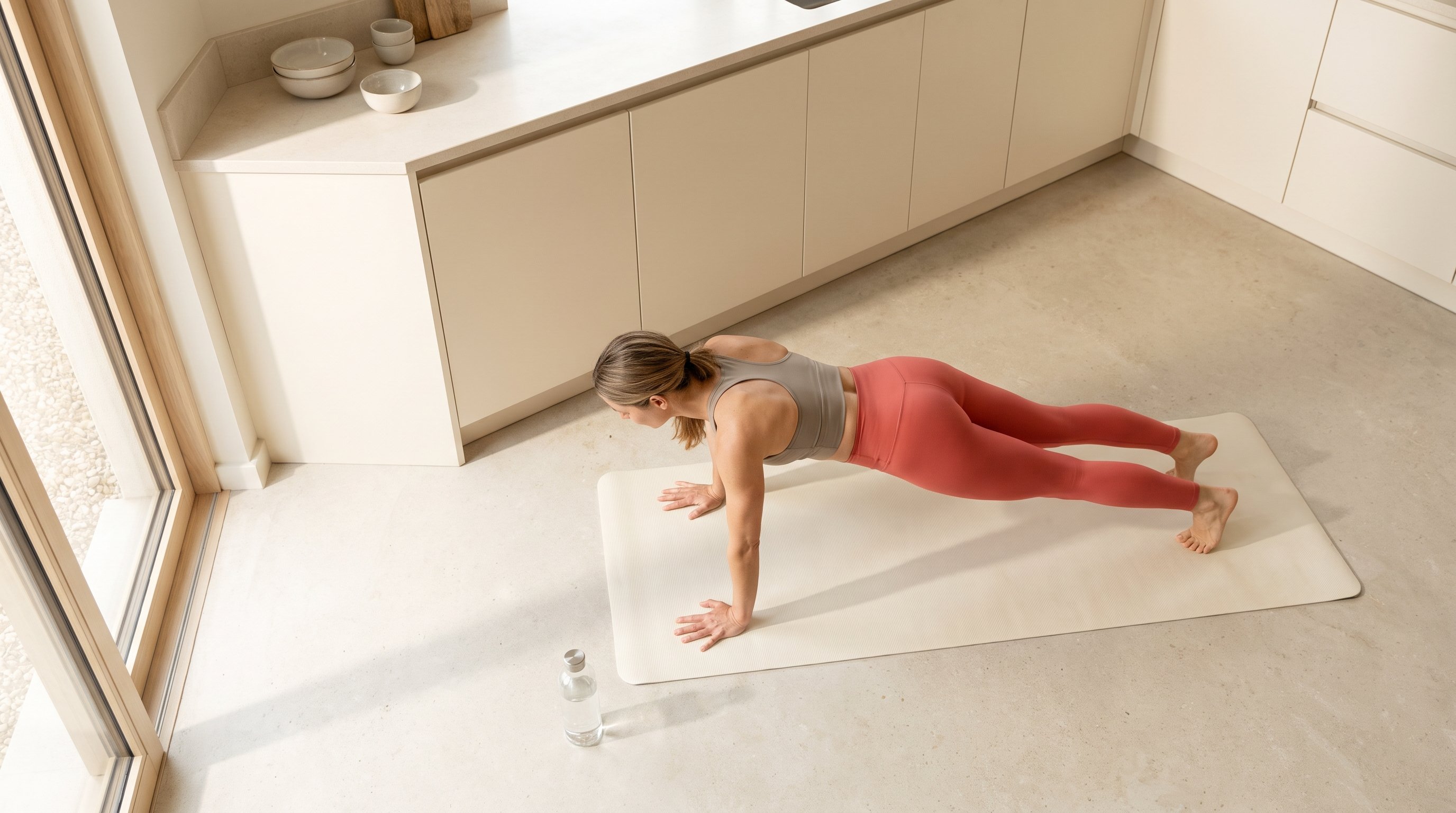
- Set your hands - shoulder-width apart, fingers pointing forward, directly under your shoulders
- Brace your core - pull your belly button toward your spine so your lower back doesn't sag
- Line up your body - head, hips and heels should form one straight line
- Lower under control - bend your elbows at roughly 45 degrees and bring your chest close to the floor
- Pause briefly - at the bottom before pressing back up, instead of bouncing
- Push through your palms - drive the floor away until your arms are straight but not locked
- Breathe with the rep - inhale on the way down, exhale as you push up
If a full push up is too much right now, drop to your knees or push against a wall or bench and build from there.
How Many Push Ups You Actually Need per Week
Finding a Starting Number
The right push up volume depends on where you're starting, not on hitting a round number for its own sake.
A useful approach is training to a level that feels challenging by the last couple of reps of a set, then repeating that across a few sessions a week.

| Level | Sets | Reps | Frequency |
|---|---|---|---|
| Complete beginner | 3 sets | 3-5 reps | 3 days a week |
| Early progress | 3 sets | 6-10 reps | 3 days a week |
| Building strength | 4 sets | 10-15 reps | 3-4 days a week |
| More advanced | 4-5 sets | 15-20 reps | 4 days a week |
Rest a day between hard sessions so your muscles can recover and actually adapt, rather than training sore muscles every single day.
Fitting a Push Up Routine Into a Busy Week
Push ups don't need a gym, a mat or even much space, which is exactly why they're easy to skip too - there's no appointment forcing you to show up.
Tying the sets to something you already do, like right after brushing your teeth or during a work break, removes the decision-making that causes people to put it off.

This is where Nordletics fits in - it builds short home workout plans around the time you actually have, so push up sessions sit alongside progress tracking instead of being one more thing to remember on your own.
A Four Week Starting Structure for Push Ups
The order below matters more than the exact numbers, since the goal is building the habit of showing up before chasing higher reps.
| Week | Focus | Work |
|---|---|---|
| Week 1 | Learn the movement | 3 sets, modified or full reps |
| Week 2 | Add a session | 3 sets, 3-4 days a week |
| Week 3 | Push rep count up | 3-4 sets, small increases |
| Week 4 | Hold the routine steady | 4 sets, consistent days |
When Push Up Progress Starts to Feel Slow
The first couple of weeks usually bring quick form improvements, which can feel like fast progress even before strength has changed much.
Somewhere around the point where reps stop increasing week to week, a lot of people assume they've hit a wall and quit - this is usually just the body catching up to the new demand, not a sign to stop.
Staying vague about exact timing is fair here, because progress depends on starting point, consistency and recovery, not a fixed calendar.
Where Push Up Workouts Commonly Go Wrong
Sagging Hips on the Way Down
This shifts load off your chest and arms and onto your lower back - reset by bracing your core and checking your body forms a straight line before each set.
Only Doing Partial Reps
Stopping halfway down trains a shorter range of motion and limits strength gains - slow the tempo down and aim for your chest nearing the floor.
Training to Full Failure Every Session
Grinding out every last rep each time leaves little left for recovery - stop a rep or two before failure on most days instead.
Skipping Rest Days
More sessions doesn't mean more progress if your muscles never get a chance to repair - space out hard sessions across the week.
Chasing Reps Over Form
A high number with poor technique builds bad patterns, not strength - drop the rep count and tighten up the movement first.
Building a Push Up Workout Habit With Nordletics
A push up workout only pays off if it gets repeated, which is more about adherence than any single hard session.
Nordletics builds simple, beginner-friendly home workout plans, pairs them with a meal plan built around food you already like, and keeps steps, water and weight in one place so you can see consistency add up over time rather than guessing at it.

Get Your Workout Plan
Train Smarter Today
Making the Push Up Workout Part of Your Routine
Push ups reward repetition more than intensity - a few consistent sets a week beat one brutal session followed by two weeks off.
Pick a level from the table above, lock in three or four days this week, and let the rest build from there - Nordletics can help keep that schedule and your nutrition pointed in the same direction.
FAQ
What matters more than a single daily number is doing a few focused sets, several days a week, at a rep count that feels challenging by the end. Spreading effort across the week tends to work better than one large daily total.
Yes - the exercise uses your own bodyweight as the resistance, so no bands, dumbbells or machines are needed. Progress comes from adjusting reps, sets and variations like knee or incline push ups.
Start with wall or incline push ups, or drop to your knees, and build reps there before moving to the floor. The same form rules still apply, just with less bodyweight to lift.
Missing a session or two doesn't erase progress - the habit matters more than any single week being perfect. Picking the routine back up, which Nordletics can help structure around your schedule, is usually enough to get back on track.
Share this post